Nikos Kazantzakis
- Home
- Nikos Kazantzakis
- The first wife, Galatea
The first wife, Galatea
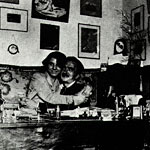 Poet, prose writer, theatrical author, translator: the feminist Galatea Alexiou was born in Herakleion, Crete, in 1881. The eldest daughter of typographer and publisher, Stylianos Alexiou, Galatea received her basic education in Herakleion, and was exposed to the world of letters from a very young age, along with her sister Elli, also a writer, and her brother Lefteris, an acclaimed poet.
Galatea first appeared in Greek letters with the prose piece, Δικταίον Άντρον(……) which was published in the Pinakotheke Literary Magazine in 1906 under the pseudonym “Lalo de Castro”, though she became widely known for her first novel, Ridi Pagliacco which was published in the Noumas Literary Magazine in 1909. Following its publication, many of her works were featured in prominent literary magazines of the period, such as the novel Women, the collection of short stories 11a.m.-1p.m., and the theatrical play While the ship sails, which was staged by the National Theater in 1933.
Ideologically, Galatea belonged to the leftist movement, with strong ties to the organization ‘Ergatike Voitheia’ of the Communist Part of Greece, and an active role in the leftist magazine, “Protopori”. Her political convictions and her radical feminist views did not impede the publication of her works during the totalitarian regime of Ioannis Metaxas, though she was arrested during the Metaxas dictatorship and was forbidden to continue with her journalistic activities.
In 1911 she married Nikos Kazantzakis in Herakleion, Crete. During the course of their common life together, Nikos and Galatea wrote and published together under the pseudonyms Petros and Petroula Psilorite, though their union was not destined to last. “…But their souls did not connect…” Kazantzakis would later write, and their marriage soon ended in divorce. To consent to the terms of the divorce, Galatea requested that she keep Kazantzakis’s surname even though she was living with Markos Avgeris at the time, whom she later married in 1933. The divorce was finalized in 1926, on the sole condition that Galatea would be allowed to keep the Kazantzakis surname, with which name she continued to author her works thereafter.
Eleni N. Kazantzakis, who had met Galatea before she knew Nikos Kazantzakis, described her as “independent and proud” (Nikos Kazantzakis: A Biography Based on His Letters, pg. 20). The works of Galatea Alexiou inhabited many literary spaces, beginning their journey in the sphere of aestheticism, in which the influence of Nikos Kazantzakis was more pronounced, and continuing in the spheres of ethography, resistance prose, and socialist realism. Today she is considered by many as the first Greek woman socialist author.
She died in Athens in 1962 after a fatal motor accident.