Nikos Kazantzakis
- Home
- Nikos Kazantzakis
- The first love, Kathleen Forde
The first love, Kathleen Forde
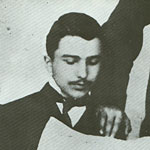 Nikos Kazantzakis’s first love was an Irish lass, his English teacher and inflamed inspiration for his fiery first novel, Serpent and Lily.1 He was eighteen years old; it was the summer of 1901 in Heraklion and this brief relationship would eventually find its way into chapter 14 of his autobiographical swan song, Report to Greco.2
“… So I threw myself heart and soul into English, that strange magical world. What joy when I began to saunter through English lyric poetry with this Irish girl! The language, its vowels and consonants, had become so many warbling birds. I stayed at her house until late at night. We talked about music, read poetry, and the air between us caught fire. As I leaned over her shoulder following the lines of Keats and Byron, I breathed in the warm acrid smell of her armpits, my mind grew turbid, Keats and Byron disappeared, and two uneasy animals remained in the tiny room, one clothed in trousers, the other in a dress.” (Report to Greco,3 Ch. 14, “The Irish Lass,” transl. Bien, P., p.130)
This passionate relationship culminated on the summit of Mount Psilorites, only a few days before Nikos was to leave Crete in order to study law at the University of Athens. They never saw each other again after this brief encounter, but Nikos was haunted by the Irish lass’s fleeting passage through his life. When he returned from Athens for the summer, he went to her house searching for her; she was long gone. “… Breaking out into a cold sweat, I headed rapidly homeward, staggering like a wounded animal. […] One moment I felt fiery hot, the next I was shivering. Obviously I had a fever. Sleep came like a poisonous spider and wrapped its web around me. When I awoke toward noon the following day, I was still quivering. This anguish lasted three days. […] On the fourth day I jumped out of bed early in the morning, and without having any clear aim in mind or knowing what I was going to do, took up my pen and began to write. This turned out to be a decisive moment in my life. Perhaps in this way, on this morning, my inner anguish would open a door for itself and escape. […] I began, therefore, to mobilize words, to regurgitate the poems, saints' legends, and novels I had read. […] I finished in a few days. Gathering together the manuscript, I inscribed “Snake and Lily” at its head in red Byzantine characters and, getting up, went to the window to take a deep breath. The Irish girl did not torment me now; she had left me in order to lie down on the paper and she could never detach herself from it again. I was saved! (Report to Greco,4 Ch. 16, “Return to Crete. Knossos,” transl. Bien, P., pp. 147-148)
The Irish lass was destined to leave an indelible mark on Nikos Kazantzakis’s life and work; in one of the drawers in his desk, until the end of his life, Nikos had kept a sealed envelop, containing every note and message the lovers had exchanged. Almost one hundred years after their relationship, Niki Stavrou traced her footsteps across the Atlantic Ocean and identified Kathleen Forde, daughter of Revd Hugh Forde, as Nikos Kazantzakis’s Irish Lass. Some time after the announcement by the Kazantzakis Publications that the Irish Lass of chapter 14 had been discovered, Niki P. Stavrou presented her findings in a speech at Trinity College, Dublin and The Irish Times published an article by Revd Patrick Comerford chronicling this remarkable story. The whole account will be chronicled in Niki Stavrou’s forthcoming book: The Lost Summer in Crete and the Fiery Circle of Women.